
Showing posts with label Winter. Show all posts
Showing posts with label Winter. Show all posts
Sunday, March 18, 2012
Hive cleaning

Saturday, March 5, 2011
Don't let your chickens get bored.
 During the cold icy winter months stay in their coop, they only go out to the field for a short period of time to forrage. They have an outdoor run that is enclosed with clear corrugated plastic so it is quite warm and sunny, but by the end of the winter months the outdoor coop is well worn. I try to add things to the coop to keep the birds occupied. I don't think it is good for them to be bored. Here are a few things I add to the coop to keep them entertained.
1. Butternut squash cut in half and put into the coop. This occupies them for several days! Just watch out if you have white crested birds, it will stain their feathers.
2. Scratch. This is essentially a special treat for chickens. It is mostly made up of oats and seeds. I love to sprinkle it on the coop floor and the hens "scratch" around for it. It helps dig up the floor and keeps them occupied for hours. Scratch should not replace regular feed, it isn't as nutritious as regular feed.
3.I also go to the local farm and get their leftover tops from beets and carrots and put that in the coop. Both of the tops are different textures and flop around so this is very entertaining. The hens also need greens during this time of year.
4. Tennis balls. I put tennis balls into the coop. The hens think it is hysterical.
Sunday, February 27, 2011

Tuesday, February 22, 2011


Monday, February 21, 2011
Late Winter Hive Check in and Feeding

February 20, 2011
42 degrees in the sun
18 inches of snow on the ground
Bright blue sky, no wind
Two hives alive, one not (Hive two has died. Oddly it was the strongest in the fall). Another winter check in went well, but it was still sort of sad. When some of the more curious bees would come to see who it was, we would tell them to stay inside, because it was only us, the beekeepers. It is one of the greatest feelings to press your ear up to the side of the hive and hear the faint buzzing of the survivors. It is also one of the worst feelings to press your ear to a hive and hear nothing... That has only happened once, and I hope it will not happen again. The little bees are strong but in some cases the bitter cold is stronger. The bees also received a bucket full of thick, sweet syrup to help them make it these last couple of weeks. Many other beekeepers have said that their hives have made it through the heart of winter, but they run out of honey a couple weeks before the nectar begins to flow again. That must bee terrible, so to avoid it we fed them. Just hang on little bees, just a few more weeks.
Saturday, February 12, 2011
Winter Bees - so so sad
I feel like I failed my bees. Two hives still buzzing, one hive done.
My bee mentors who have 10 hives have lost 4.
I am going to start feeding my other hives this week 2/14/11
My bee mentors who have 10 hives have lost 4.
I am going to start feeding my other hives this week 2/14/11
Tuesday, February 1, 2011
Guest Blog Post from - Alex Jokela: Beekeeping in Minnesota!

Ice crystals around the front door in MN.
It is January in northern Minnesota. This means we have had much snow which is usually followed up with several severe cold days and nights. Night time temperatures, at their coldest, will reach down to -40F without the wind. How does one keep bees in colder climates? For me, it started with planning. My planning started in August while attending the Eastern Apiculture Society's annual conference (held in Boone, NC, last year). I quizzed any master beekeeper who was from a northern state and who would give me a couple minutes of their time. Valuable common sense tidbits that I assembled, in piecemeal fashion, into comprehensive plan.
Moisture Control.
Growing up, while hunting whitetail deer with my father, I learned to pace yourself while hiking in the woods. You did not want sweat. As soon as you stopped to wait for the occasional deer to wander by, you would become cold faster with the moisture on your body.
The same principle of moisture and cold holds true with beehives. Moisture + cold is a perfect equation for ending up with a pile of frozen, dead bees mid-winter. To control excess moisture (remember, bees shiver in the winter to keep the collective warm; lots of moisture is given off with the shivering), a master beekeeper from Maine recommended using homasote board as an inner cover. A piece the length and width of your top super is cut, and then, using a router with a rabbiting bit, a groove is routed out from middle of the piece - roughly halfway through the material - to one edge. This will be your top entrance for the winter.
On top of the homasote, a 2" wood spacer is used. Inside the space, a piece of rigid foam insulation cut to snugly fit. The outer cover is then placed over the spacer with care being taken to not cover the cut-groove in the homasote.
Insulation Wrap.
I picked an insulation-blanket-type wrap. It is covered in a heavy-mil black plastic. The insulation is loose enough to trap air between itself and the hive boxes while the heavy plastic is useful for keeping out drafts. The wrap is pulled up and secured just below the groove in the homasote board.
As a side note, I use screened bottom boards during the warmer months; to prevent updrafts into the hives, I slid a solid piece under the screens. The bottom entrance is still accessible, but gets covered with snow.
It is very important to make sure that the top entrance remains accessible; this will be the bees' link to the outside world while their bottom entrance is in the snow.
Wind Break.
We have a taller fence to the east and north of the hives. These are the predominant directions the winter winds blow from. Even though the hives are wrapped snug and warm with insulation, there is the fence to act as a wind break. The fence, during the warmer season when the bees are active, also forces the bees to enter and leave the hives at a very steep angle - well above the yards of any neighbors.
Depending upon the size of your apiary, it might not be conducive to put up solid fencing; instead it might be enough or more time-economical to have the top entrance facing away from the predominant wind direction.
Lastly, food. This is a tricky one. You want to harvest enough honey for yourself, but you also need to leave enough for your bees for the winter. It gets trickier if you get an extra cold snap that causes the bees to "lock up" and be unable to reach the food stores. A beekeeper friend had this happen last year; in the spring, there was plenty of food stores left, but all his bees frozen out directly under the food.
By day, Alex is a programmer and data analyst for the University of Minnesota Duluth. But, in his off time, he tends bees and gardens. He is also actively involved in basset hound and coonhound rescue - he and his wife, Melissa, own two bassets and two coonhounds. He blogs about bees and gardening at http://snowshoe-farm.com/blog
Sunday, January 23, 2011

Saturday, January 22, 2011
What you can do for your hens when it is dangerously cold
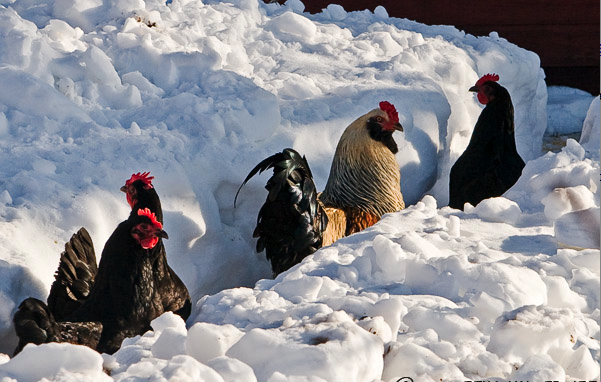
Picture from EthanMiller.net
This weekend there are supposed to be 3 or 4 days where the temperature doesn't get above 10 degrees with the overnight temperatures well below zero. I don't know what the windchill will do to the temperature.
Here are a few things I do to help my hens.
1. Make sure there is always plenty of fresh water! I use a heated dog bowl which is quite big so if for any reason I can't get there right away they will have enough water.
2. I make sure they have really deep shavings. I actually use an entire bag of shavings per coop.
3. Today I put 1 heat lamp (on a timer) in each coop so overnight when it gets dangerously cold they have a place to perch and keep warm.
4. I added a little extra cracked corn and gambird feed to their food mix. The gamebird feed is higher in protein and the cracked corn I understand takes some work to digest so keeps their body temp up.
5. I put vaseline on all combs to protect against frost bite.
6. I check them often.
Thursday, December 30, 2010
Why do my hens stop laying eggs in winter?

Many people ask me what they can do to help keep their hens laying eggs during the winter. Here are a few things to consider:
1. Make sure your hens have plenty of fresh clean water all day long. Don't let it freeze over night then replace in the morning. I use heated dog bowls.
2. I use lights (on timers) in my coop so that my hens have 14-16 hours of light a day.
3. Add a bit more protein to their feed. I add a bit of gamebird crumble to the regular feed. Also consider adding cracked corn and ground flaxseed to their feed.
4. Try and add some greens to your hens feed. I go to our local farm and get the leftover lettuce and carrot tops. It is also great entertainment for hens.
5. Keep the coop draft free.
6. I also try to add something to the coop so that they are entertained. Scratch is a great thing! They love digging about for it.
More winterizing tips.
Saturday, November 20, 2010
Sunlight in the winter
Chickens need a lot of sunlight. I think that the steady supply of light in the coop contributes to good wintertime egg production and Happy Chickens!
I do two things to help with light for my hens:

1. See above. My dad and I enclosed the outdoor run in clear corrugated plastic, so it is both warm and sunny all day. I have seen coops where the outdoor run is closed in during the winter with wood, so the coop is dark all day. I try to get as much light to them as possible. The indoor coop is well lit because the roof of the barn has some clear panels as well.
2. I set up a crazy light / timer system for the indoor coop.
- Set a plug-in timer to come on at 4pm and off at 8pm.
- Then I clip these industrial lights on the overhead beams of the coop and the light comes on when it gets dark outside. Hens need anywhere from 14-16 hours of light a day.
I do two things to help with light for my hens:

1. See above. My dad and I enclosed the outdoor run in clear corrugated plastic, so it is both warm and sunny all day. I have seen coops where the outdoor run is closed in during the winter with wood, so the coop is dark all day. I try to get as much light to them as possible. The indoor coop is well lit because the roof of the barn has some clear panels as well.
2. I set up a crazy light / timer system for the indoor coop.
- Set a plug-in timer to come on at 4pm and off at 8pm.
- Then I clip these industrial lights on the overhead beams of the coop and the light comes on when it gets dark outside. Hens need anywhere from 14-16 hours of light a day.


Subscribe to:
Posts (Atom)